The TallyBoat Ecosystem
The TallyBoat Ecosystem
Explore the TallyBoat Ecosystem: one connected digital infrastructure for the people, companies and operations of the yachting industry.
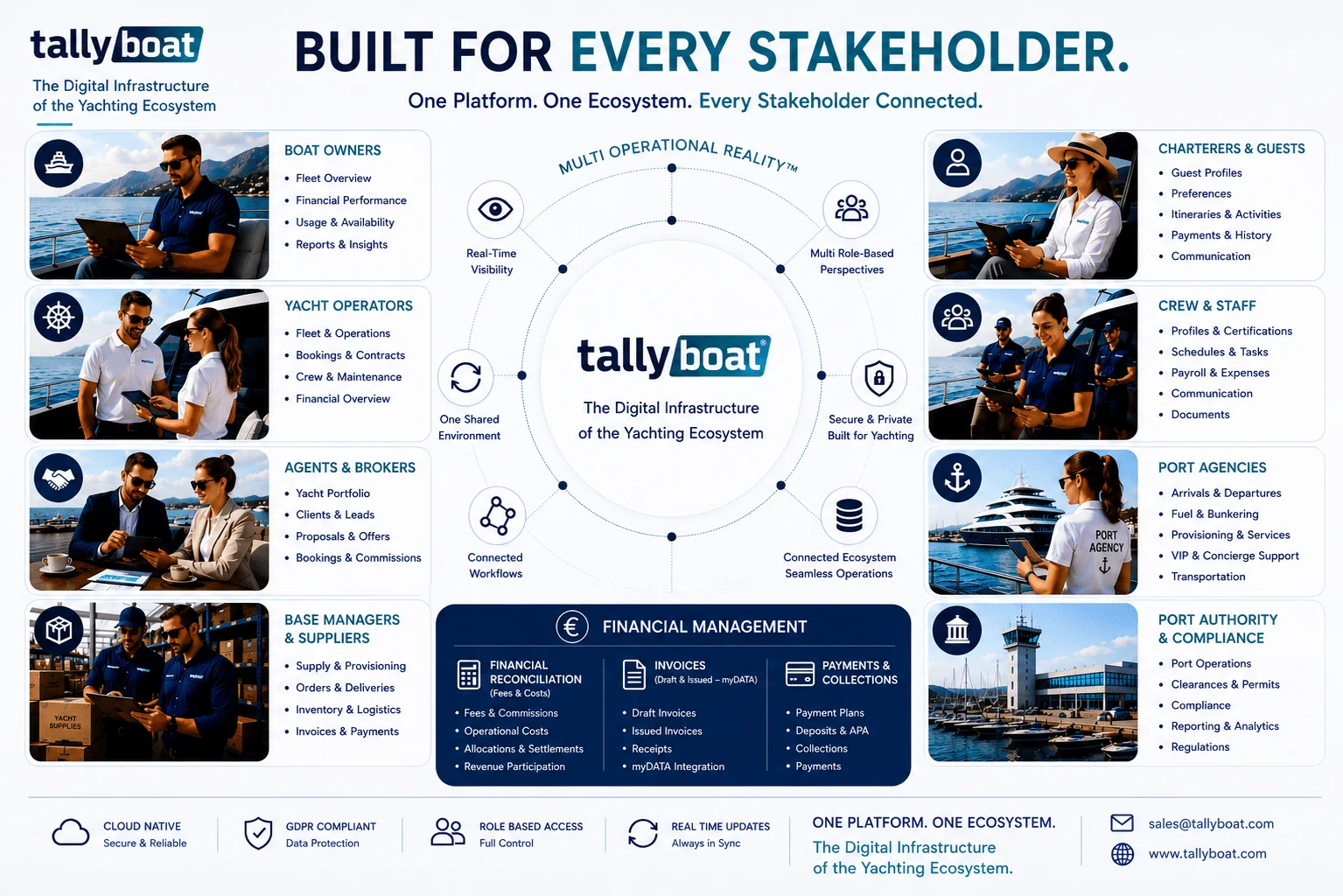
The TallyBoat Ecosystem connects a complex yachting industry involving yacht owners, management companies, brokers, crew members, suppliers, technical contractors, port agents, charterers, and many other professionals.
Each participant has their own operational needs, responsibilities, commercial relationships, and financial activities. At the same time, many of their activities are interconnected and form part of shared business operations.
The TallyBoat Platform is designed to serve as the common digital infrastructure of this ecosystem, connecting people, companies, yachts, products, services, and operational activities within one unified environment.
1. TallyBoat Ecosystem: One Platform for the Entire Yachting Industry
Most businesses in the yachting industry use different tools to manage their daily operations.
A yacht management company may use a booking system, separate applications for maintenance and procurement, spreadsheets for financial monitoring, and email to communicate with business partners.
Similarly, a broker, supplier, or technical contractor may maintain their own independent systems and records.
TallyBoat approaches this reality through a different architecture: one shared platform where each participant manages their own activities while connecting with other stakeholders through common business operations.
This connectivity creates opportunities for better coordination, organized information sharing, clearer responsibilities, and more effective management of business relationships.
2. The Eight Main Stakeholder Categories
The TallyBoat Ecosystem includes eight main stakeholder categories, covering different roles and activities across the yachting industry.
Boat Owners
Individuals and companies that own yachts and require organized information about their assets, management activities, charters, maintenance, expenses, and financial results.
Yacht & Charter Managers
Businesses responsible for daily yacht operations, commercial utilization, and yacht management, coordinating bookings, crew, suppliers, technical work, and financial activities.
Brokers & Charter Agents
Professionals and businesses managing customer enquiries, quotations, bookings, charters, yacht sales, and related commercial partnerships.
Port Agents & Marina Support
Businesses and professionals coordinating yacht port calls, port procedures, marina services, and other local operational requirements.
Technical Contractors & Service Providers
Businesses providing maintenance, repairs, technical work, equipment, spare parts, supplies, and yacht support services.
Crew & Operations Assistants
Professionals involved in daily yacht operations, task execution, guest services, and operational coordination.
Finance, Legal & Family Offices
Professionals supporting financial monitoring, document management, contractual obligations, compliance, and business oversight.
Charterers & Guests
Customers and passengers participating in booking, charter, service delivery, information exchange, and guest-related processes.
Each participant may hold different roles, collaborate with multiple companies, and participate in several business activities.
3. How Stakeholders Connect Through a Shared Operation
To understand how the ecosystem works, consider the example of a yacht charter.
A charterer wishes to book a yacht through a broker.
The broker collaborates with a yacht management company, which coordinates yacht availability, the charter, and the required operational procedures.
The yacht owner participates according to the commercial and management agreement in place.
Crew members and operational partners prepare the yacht, while external suppliers may provide additional products and services.
At the same time, financial obligations, invoices, payments, fund transfers, and financial reconciliations arise between the participants.
Although everyone participates in the same charter, each party has different responsibilities, information requirements, and financial relationships.
TallyBoat enables these activities to be organized through connected operational records, supporting collaboration according to each participant’s role and access permissions.
This approach forms the foundation of Multi Operational Reality™, which is explored in the Multi Operational Reality™ guide.
4. The Operational Modules of the Ecosystem
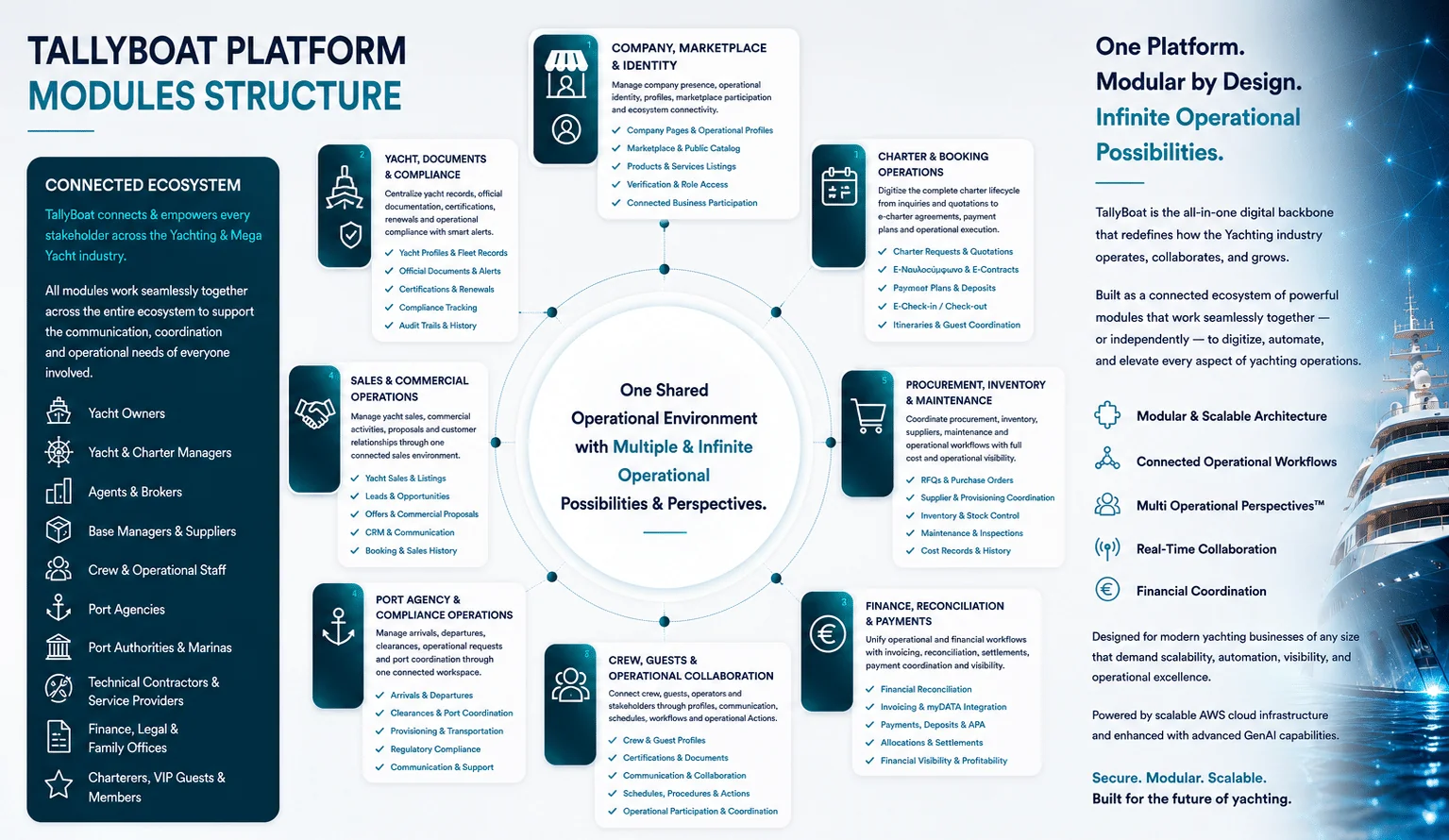
TallyBoat organizes its capabilities into operational modules that support the different needs of ecosystem participants.
| Operational Module | Purpose |
|---|---|
| Company, Marketplace & Identity | Organization of companies, accounts, profiles, products, services, and business relationships. |
| Yacht Management, Documents & Compliance | Management of yacht information, documents, certifications, and operational obligations. |
| Charter & Booking Operations | Organization of bookings, charters, participants, and related processes. |
| Yacht Sales & Commercial Activities | Support for commercial activities and yacht sales processes. |
| Procurement, Inventory & Maintenance | Management of requests, procurement, inventory, technical work, and maintenance. |
| Financial Coordination, Payments & Reconciliation | Connection of business operations with financial obligations, invoicing, payments, and financial reconciliation. |
| Crew, Guests & Collaboration | Collaboration between crew members, guests, and operational teams. |
| Port Agency & Operational Compliance | Coordination of port services and related operational procedures. |
These modules operate through common architectural principles and connected business entities.
As a result, an activity may begin with a request, develop into a quotation or order, connect to a specific yacht or service, and reach completion through execution, documentation, and financial processes.
5. Business Autonomy and Connected Processes
A fundamental characteristic of the ecosystem is that every business maintains its own identity, responsibilities, and commercial relationships.
For example, a yacht management company may collaborate with multiple yacht owners, brokers, suppliers, and technical contractors.
Each collaborating business can participate in relevant activities according to its own role and corresponding access permissions.
TallyBoat connects operational activities while preserving each party’s distinct participation and responsibilities.
This supports a collaborative business model in which information and actions are organized around real business relationships.
6. The Value of a Shared Digital Infrastructure
A shared digital infrastructure enables ecosystem participants to organize their activities more effectively and collaborate through connected processes.
The main benefits include:
- Better Information Organization: Connecting companies, yachts, documents, products, services, and operational records.
- Partner Coordination: Enabling different professionals to participate in the processes relevant to them.
- Operational Traceability: Tracking requests, actions, orders, and task completion.
- Financial Transparency: Connecting business operations with invoicing, payments, financial obligations, and reconciliation.
- Flexibility and Growth: Supporting different business activities through one shared infrastructure.
TallyBoat’s long-term objective is to support the digital transformation of the yachting industry by creating an environment where participants can grow their businesses and collaborate more effectively.
Continue exploring the TallyBoat Platform overview or return to Welcome to TallyBoat for introductory guidance.